“I’ll remember that later.”
It is an easy promise to make after a busy shift. You remember what happened, the details seem clear, and writing it down feels like something that can wait until you get home.
Then the evening happens. There is traffic, dinner, a phone call, and everything else that needs your attention. When you finally sit down, you remember the moment, but some of the details are harder to recover.
Home care documentation helps preserve those details. Clear caregiver shift notes record the care provided, relevant observations, and information that may matter to the next person supporting the client.
Consider Stan and Brian, 2 caregivers facing a familiar decision.
“I’ll Write It Down When I Get Home”Copy link
Stan has just finished his shift when he remembers something worth recording. His client declined a planned activity and asked to try it during the next visit.
It does not require immediate action. Stan decides to write it down later.
Brian notices something similar during his own shift. When it is safe to pause, he opens his agency’s documentation app and records what the client said, what he offered, and what happened next.
By evening, Stan remembers the general situation. But what exactly did the client ask? Did they want to try again tomorrow, or simply another day?
Brian already has a record.
The difference is not that Brian cares more or has a better memory. He captured the information while it was still clear.
Memory is useful. It isn’t a record.
What Should Caregivers Include in Shift Notes?Copy link
A useful caregiver note gives the next reader enough information to understand what happened during the visit.
The exact requirements depend on your agency, your role, and the client’s care plan. Use your agency’s required forms and instructions, with these questions as a starting point:
- When did it happen? Record the visit date and relevant times.
- What care did you provide? Describe the tasks completed and the support given.
- Was anything not completed? Explain what was declined, postponed, or could not be done.
- What did you observe? Include relevant changes or details, using factual language.
- What did the client say? Include their exact words when useful and accurately remembered.
- What happened next? Record actions taken, who was notified, and any follow-up instructions received.
Not every entry needs to be long. It needs enough detail to be useful.
“Helped with lunch” tells the reader that something happened. A brief description of what was prepared and what assistance was provided gives them a clearer picture.
How to Write Clear Caregiver NotesCopy link
Record details while they are freshCopy link
Whenever it is safe and appropriate, record relevant information during the visit or promptly afterward, following your agency’s process.
The aim is to make documentation part of the workflow without interrupting care that needs your attention.
If something requires urgent action, follow your agency’s reporting and emergency procedures. Writing a note does not replace contacting the appropriate person.
Describe what happenedCopy link
Use specific, respectful language. Write what you observed, what the client told you, and what you did.
“Client was difficult” expresses a judgment. “Client declined the planned walk and asked to remain indoors” describes an event.
That distinction helps another person understand the situation without inheriting the writer’s assumptions.
Include relevant times and detailsCopy link
A time, an amount, or a short description can make a note easier to interpret.
Use exact information when you know it. If something is an estimate, make that clear. Do not fill gaps with details you cannot confidently recall.
Make longer notes easy to scanCopy link
For longer entries, short paragraphs or simple labels such as “Care provided,” “Observations,” and “Follow-up” can help readers find important information.
Follow your agency’s preferred format and use approved abbreviations only. The next reader should not have to guess what you mean.
Caregiver Notes Example: Vague vs. UsefulCopy link
Here is an example of how a little more detail can improve an entry.
Vague note:
“Client was fine. Helped with lunch.”
More useful note:
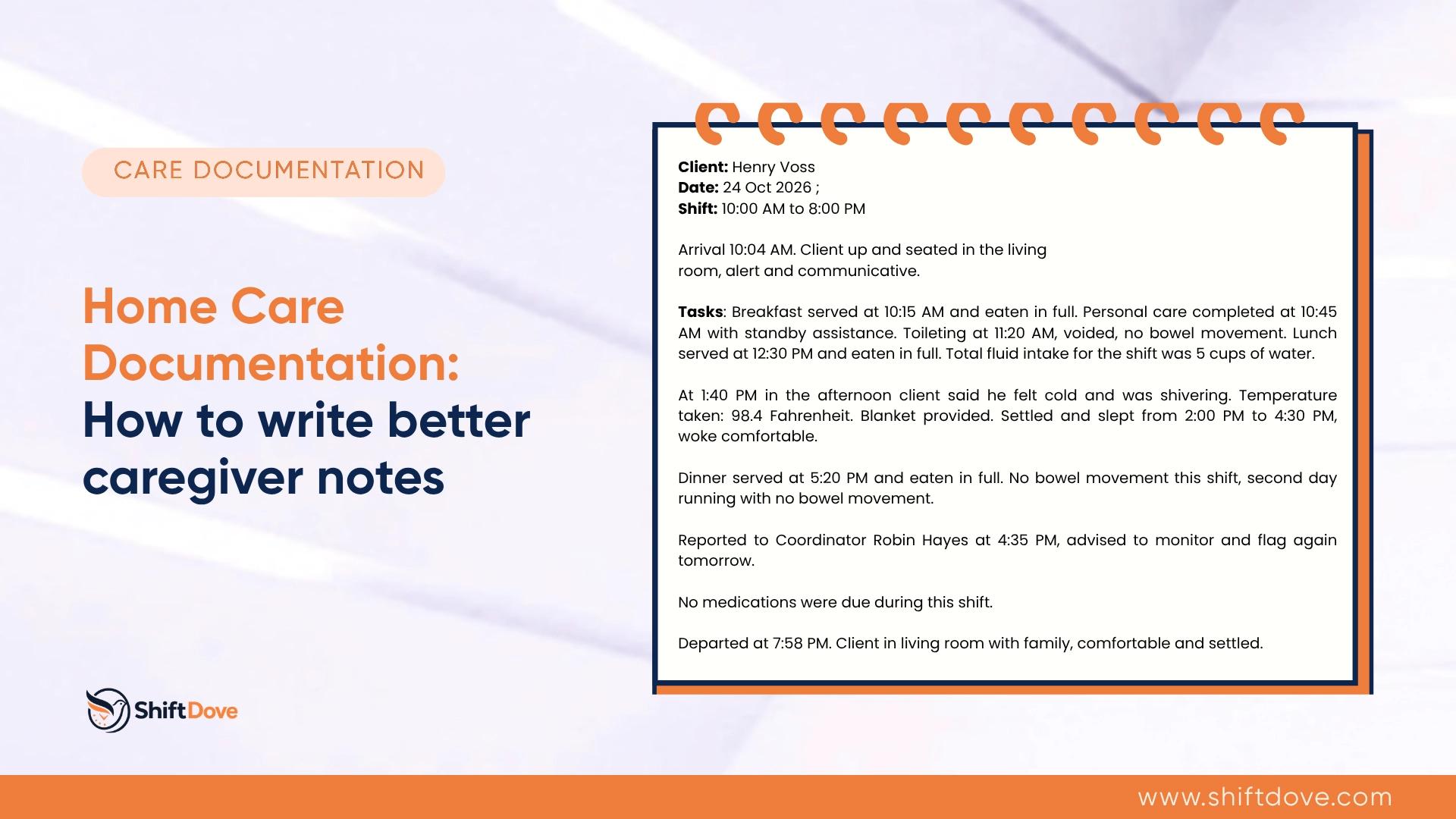
“12:15 PM: Prepared a sandwich and sliced apple. Client ate the sandwich and approximately half the apple. Washed dishes and cleared the kitchen counter. Client requested that the remaining apple be saved for later.”
The second version explains what happened without becoming a long story. It records the task, an observation, and the client’s request.
This is an example of one entry, not a complete shift record. Your agency may require additional information elsewhere in its documentation.
How Shift Notes Support Continuity of CareCopy link
A caregiver’s note can remain useful after their shift ends.
Another caregiver may need context for the next visit. A coordinator may need to clarify an incomplete task. An authorized team member may review earlier observations to understand a concern.
Clear notes give those conversations a starting point.
If Stan records that his client declined an activity and asked to try again during the next visit, the next caregiver has something useful to work with. Without that record, the request may never reach them.
Documentation does not replace a conversation when one is needed. It helps preserve the information that should remain available afterward.
How ShiftDove Helps Caregivers Record Shift NotesCopy link
Good documentation habits are easier to maintain when caregivers have a practical place to write.
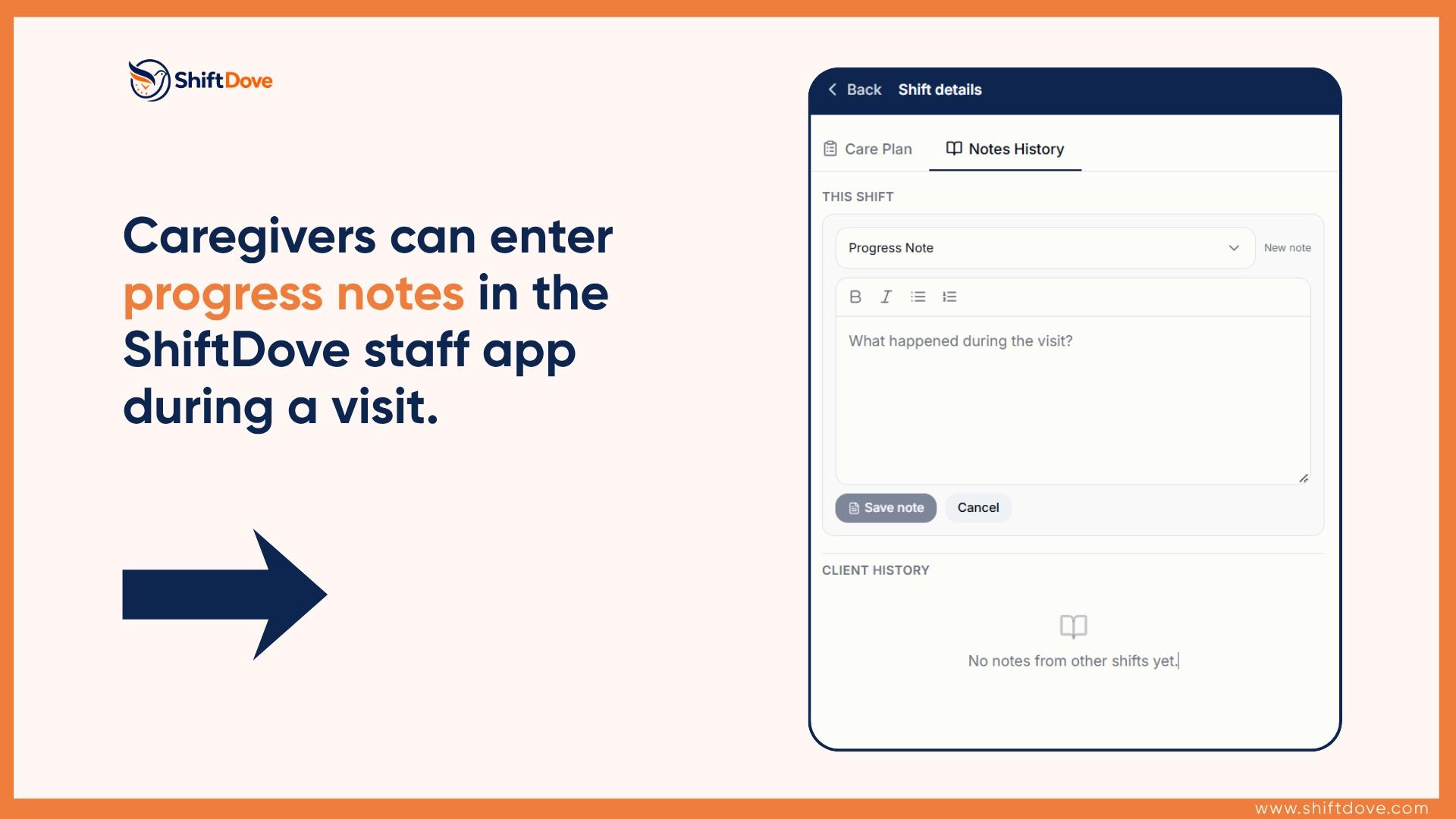
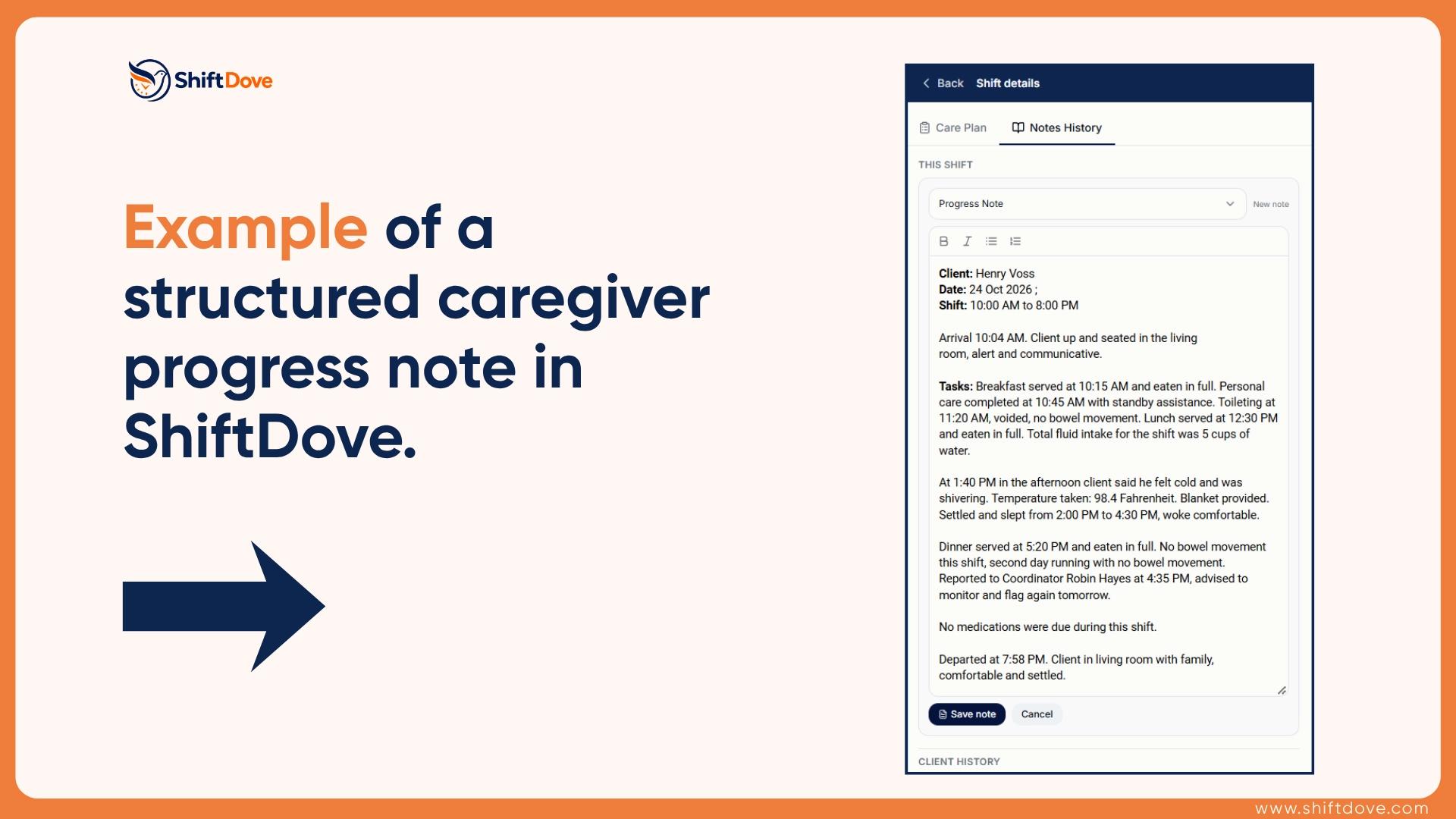
The ShiftDove staff app allows caregivers to submit notes alongside the tools they use during their workday. In the note editor, caregivers can enter a progress note and use formatting options to organize longer entries.
That gives someone like Brian a way to capture an observation during the visit, when it is safe to pause, instead of keeping it in his head until later.
Before saving, caregivers should check that the note belongs to the correct client and shift, review the details, and follow their agency’s submission process.
For agency owners and coordinators, it is worth asking: Is it clear where staff should record information, what they should include, and how concerns should be communicated?
Software supports that process. Clear expectations help the team use it consistently.
Common Questions About Home Care DocumentationCopy link
How long should caregiver notes be?Copy link
Long enough to explain the relevant care, observations, and actions taken. A routine entry may be brief. A more involved situation may need additional detail.
Follow your agency’s requirements rather than aiming for a particular word count.
What if I remember something after submitting a note?Copy link
Follow your agency’s process for a late entry or correction. Make the timing clear and include only what you can accurately recall. Do not make a later entry appear as though it was written during the visit.
Are progress notes and incident reports the same?Copy link
They serve different purposes. Progress notes generally record care and observations during a visit. An incident report documents an event that requires reporting under your agency’s procedures.
Some situations may require both, along with direct notification. Follow your agency’s instructions.
Make Clearer Notes Part of the WorkdayCopy link
Caregivers have a lot to hold in mind. Documentation should help them carry that responsibility, not become another task they struggle to finish at home.
For Stan, a better habit starts with a small change: recording the detail when it is safe to pause, while it is still clear.
For an agency, it starts with giving staff clear expectations and a practical way to follow them.
ShiftDove brings note submission into the staff app alongside the information caregivers use during their visits.
Want to see how it could fit your agency’s documentation workflow?