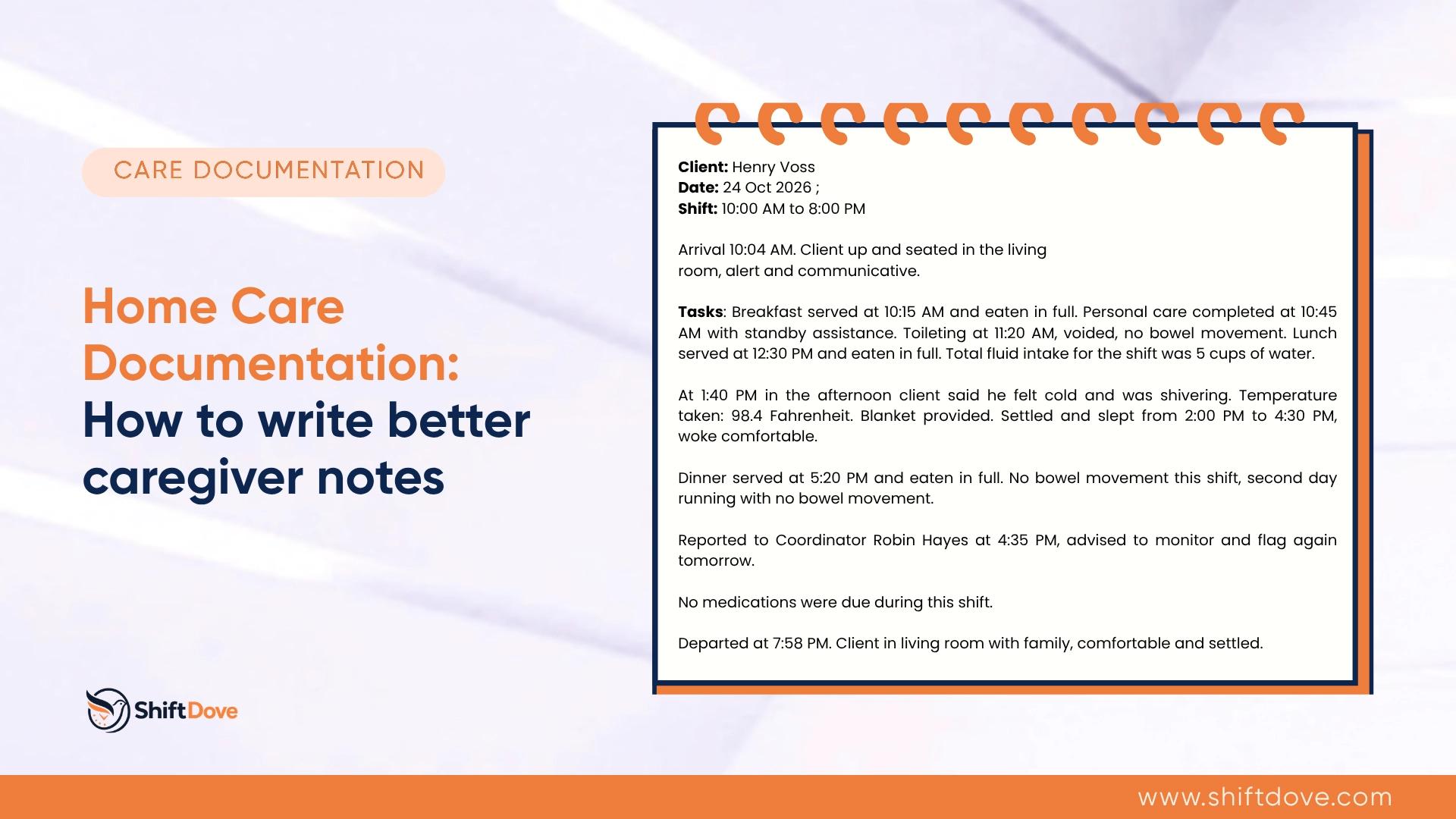
Every shift ends the same way. The caregiver says goodbye, picks up their bag, and writes a few lines about what happened. Those few lines decide more than most people realise.
They are what the next caregiver reads before walking in. They are what the coordinator checks when a daughter calls asking why her mother seemed confused on Tuesday. They are what an auditor asks for. They are what supports the invoice. And if something ever goes wrong, they are the only account of the visit that will be taken seriously.
We see this up close. Agencies on ShiftDove have now scheduled more than 5,200 shifts and delivered more than 22,800 hours of care through the platform, with more than 2,400 verified timesheets behind them. That is a lot of care notes, and the single clearest pattern in them is this: two caregivers can deliver equally good care on the same day and leave behind records of completely different value. One note tells you everything. The other tells you a shift happened.
This guide is about closing that gap. It covers what separates a good care note from a poor one, more than twenty copyable examples across different types of care, what schedulers and administrators should look for, how to make sure shift tasks actually show up in the notes, and how to turn months of notes into a reliable history of a client's care.
Table of contentsCopy link
1. What a care note is actually forCopy link
A care note, also called a shift note, visit note, or progress note, is the written record of one visit. It says what the caregiver saw, what they did, how the client responded, and anything that needs to happen next.
It has at least five jobs at once:
Continuity - The next caregiver should be able to read it and walk in knowing exactly where things stand.
Early warning - Small changes, eating less, sleeping more, a new bruise, more confusion than usual, rarely look important on one day. Across a week of notes they become a pattern someone can act on.
Proof of care - In home care there is an old line that still holds: if it was not documented, it was not done. A note is evidence that the visit and each task actually happened.
Billing and payroll support - The note backs up the hours on the timesheet and the invoice to the client or payer.
Protection - For the client, the caregiver, and the agency. When there is a complaint, a fall, or a dispute, a clear note written at the time is worth far more than anyone's memory a month later.
A note that only proves a shift happened does none of these jobs well.
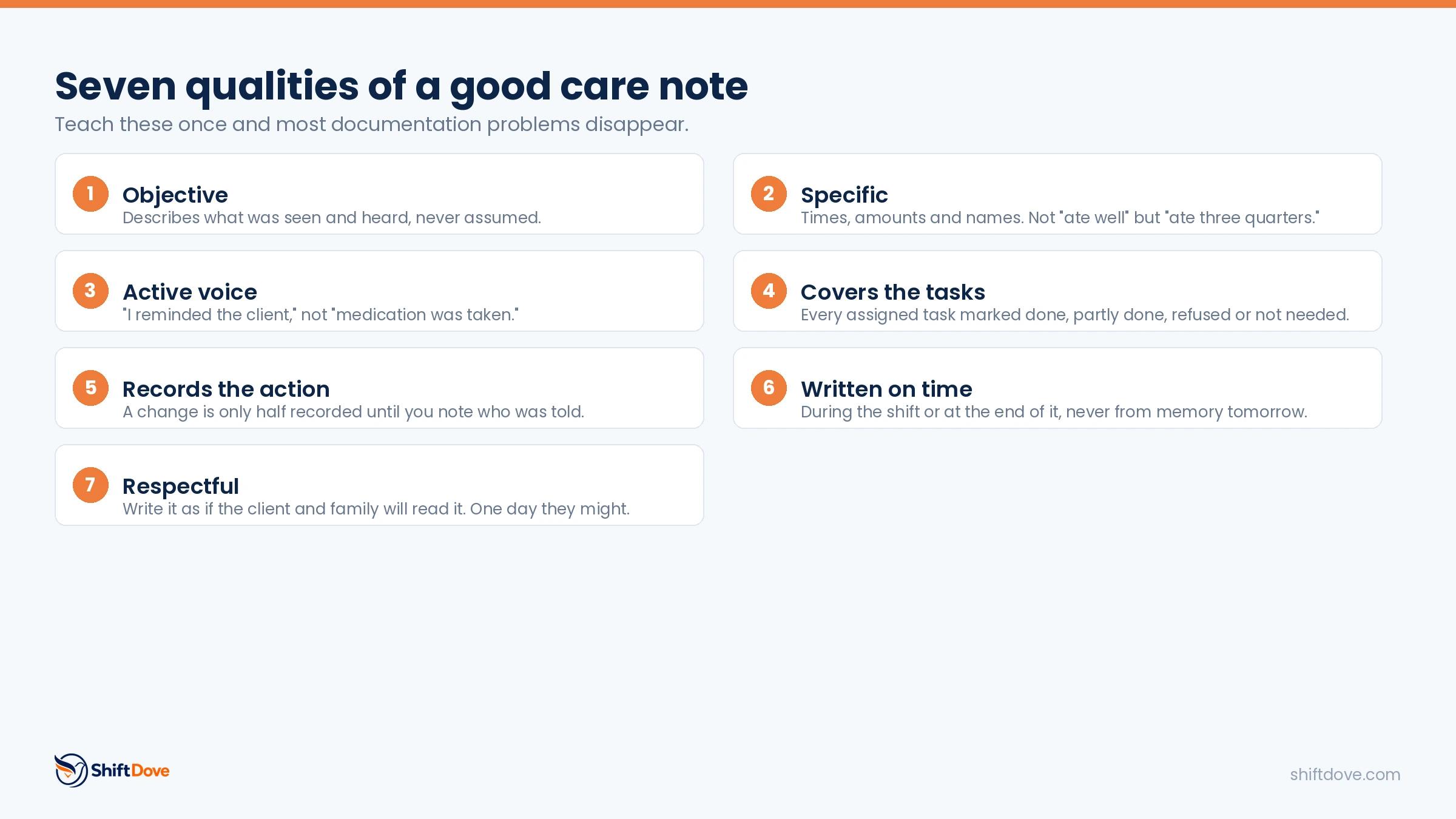
2. The seven qualities of a good care noteCopy link
1. It is objective. It describes what was seen and heard, not what the caregiver assumed. "Client was grumpy" is an opinion. "Client said 'leave me alone' twice and turned away when offered breakfast" is a fact anyone in the room would agree with. A useful test: could a second person who was there disagree with the sentence? If yes, rewrite it.
2. It is specific. Times, amounts, and names. Not "ate well" but "ate about three quarters of a bowl of oatmeal and drank one cup of tea." Not "helped with bathing" but "assisted with a seated shower, client washed face and arms independently."
3. It is written in the active voice. "Medication was taken" leaves a question: taken by whom, given by whom? "Reminded client to take 8:00 AM medication from the labelled blister pack; client took it with water at 8:10 AM" leaves none.
4. It covers the shift tasks. Every task assigned to the visit is accounted for: done, partly done, refused, or not needed, with a reason when it was not done.
5. It records changes and what was done about them. A change in condition is only half recorded until the note also says who was told, when, and what they said.
6. It is written on time. During the shift or at the end of it, never from memory the next day, and never before the care has happened.
7. It is respectful. Clients and families can request their records. Write every note as if the client will read it, because one day they might.
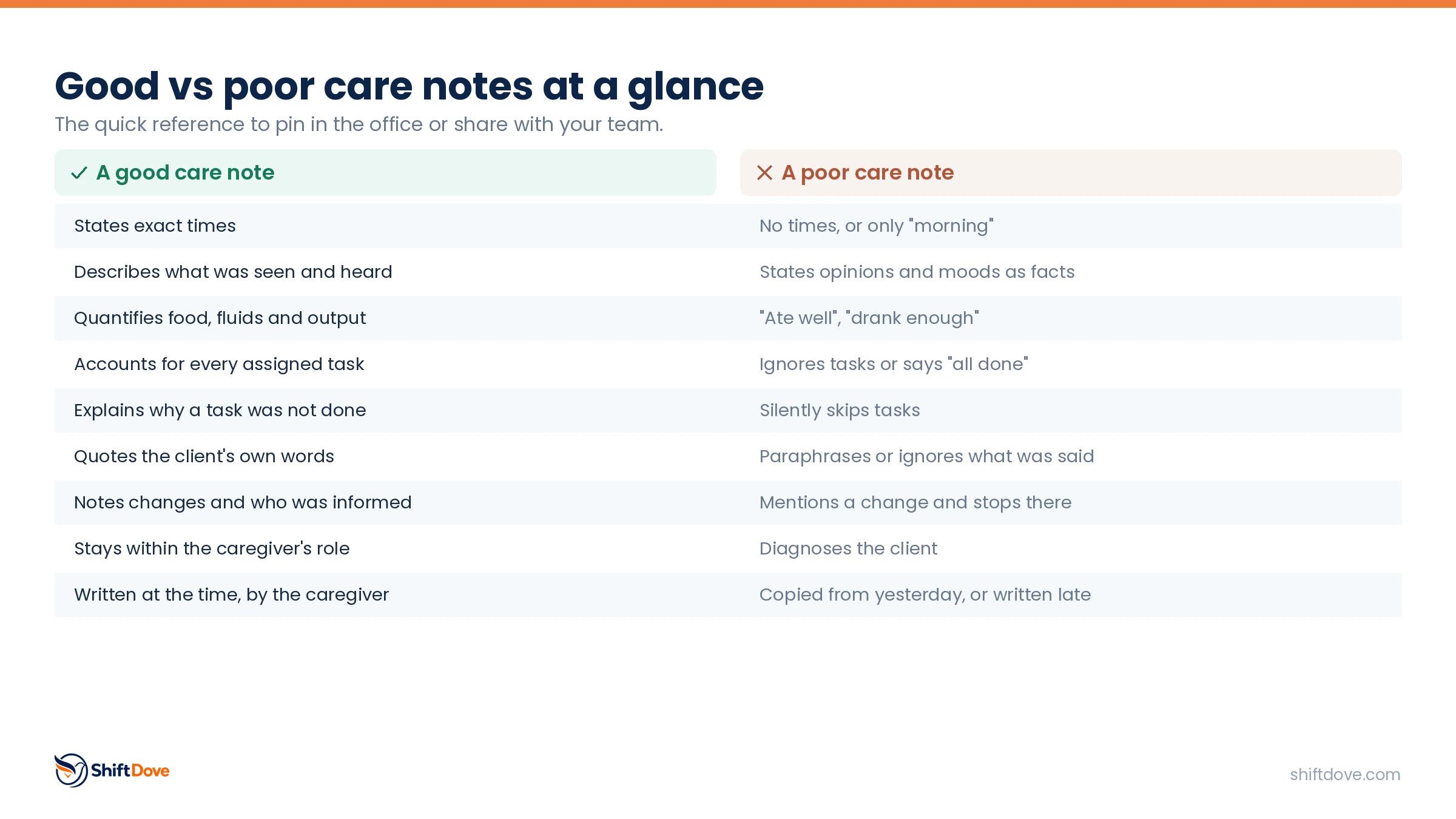
3. Good vs poor care notes at a glanceCopy link
| A good care note | A poor care note |
|---|---|
| States times: "At 10:15 AM..." | No times, or only "morning" |
| Describes what was seen and heard | States opinions and moods as facts |
| Quantifies food, fluids, and output | "Ate well", "drank enough" |
| Accounts for every assigned task | Ignores tasks or says "all done" |
| Explains why a task was not completed | Silently skips tasks |
| Records the client's own words in quotes | Paraphrases or ignores what the client said |
| Notes changes and who was informed | Mentions a change and stops there |
| Uses plain, professional language | Slang, unclear abbreviations, or emotional language |
| Stays within the caregiver's role | Diagnoses ("client has a UTI") |
| Written at the time, by the person who gave the care | Copied from yesterday, or written hours later |
| Respectful in tone | Judgemental ("difficult", "lazy", "refused to cooperate as usual") |
4. A simple structure caregivers can follow every timeCopy link
Professional formats exist. SOAP (Subjective, Objective, Assessment, Plan) is common in clinical settings. DAR (Data, Action, Response) suits focused entries. Both work, but most home care aides are not clinicians and do not need clinical frameworks. They need something they can remember at 9:45 PM after a long shift.
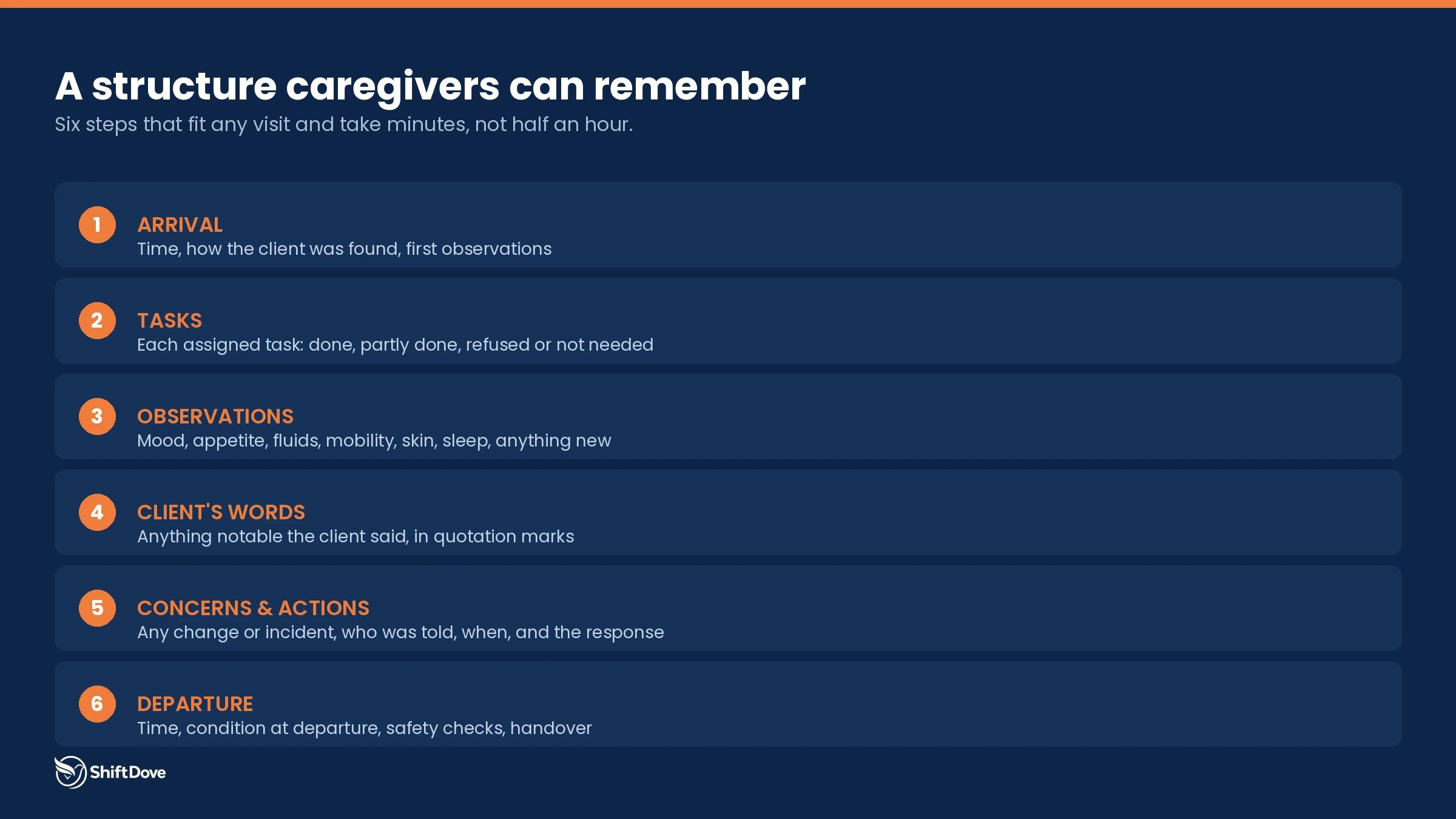
This six-part structure works for almost every non-medical visit:
Try this structure free on ShiftDove · Free forever for agencies with up to 5 caregivers.
5. Care note examples by type of careCopy link
All names below are fictitious. Copy any of these and adapt them for training, templates, or onboarding packs.
Example 1: Companion careCopy link
Poor:
Good:
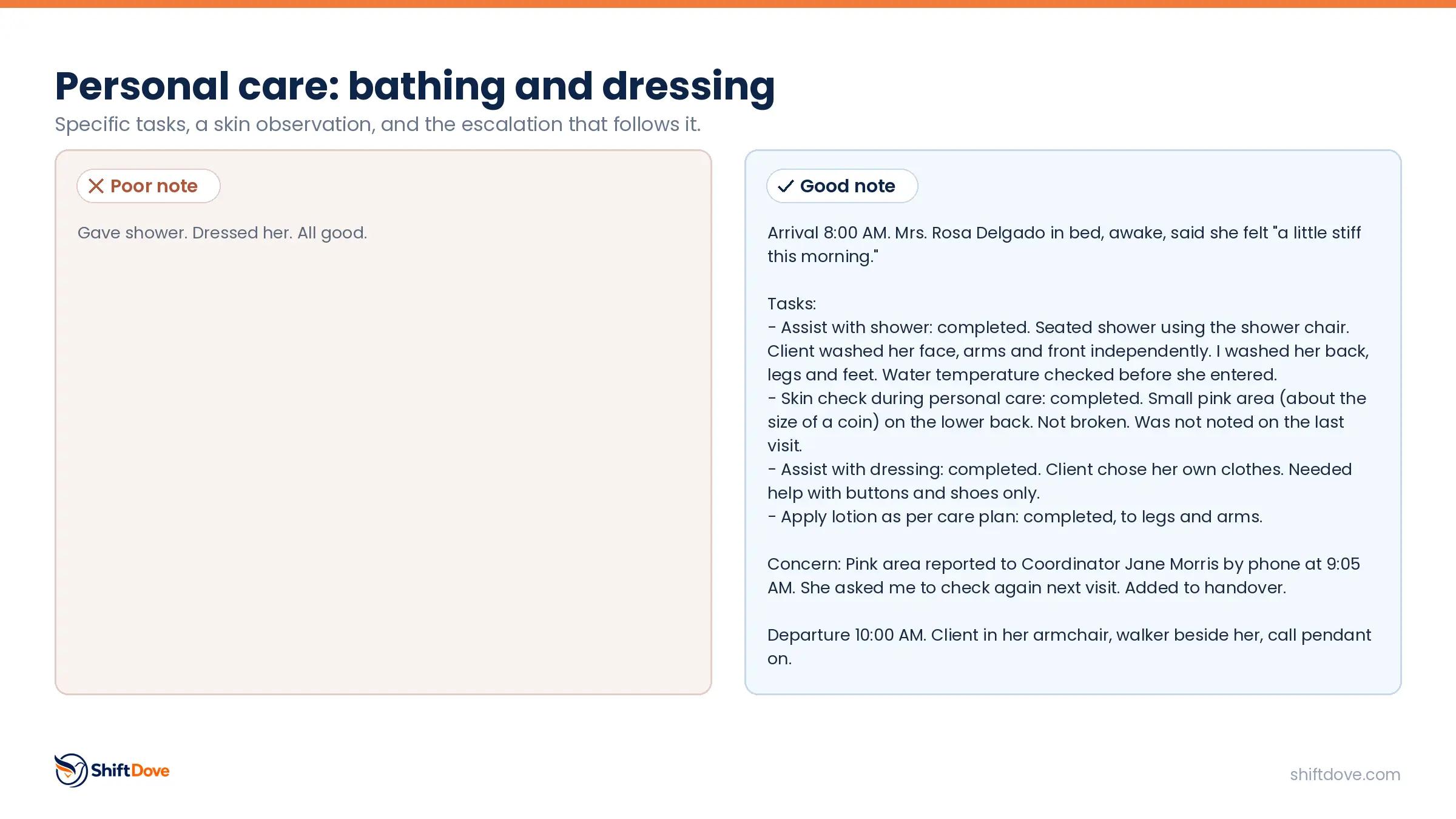
Example 2: Personal care, bathing and dressingCopy link
Poor:
Good:
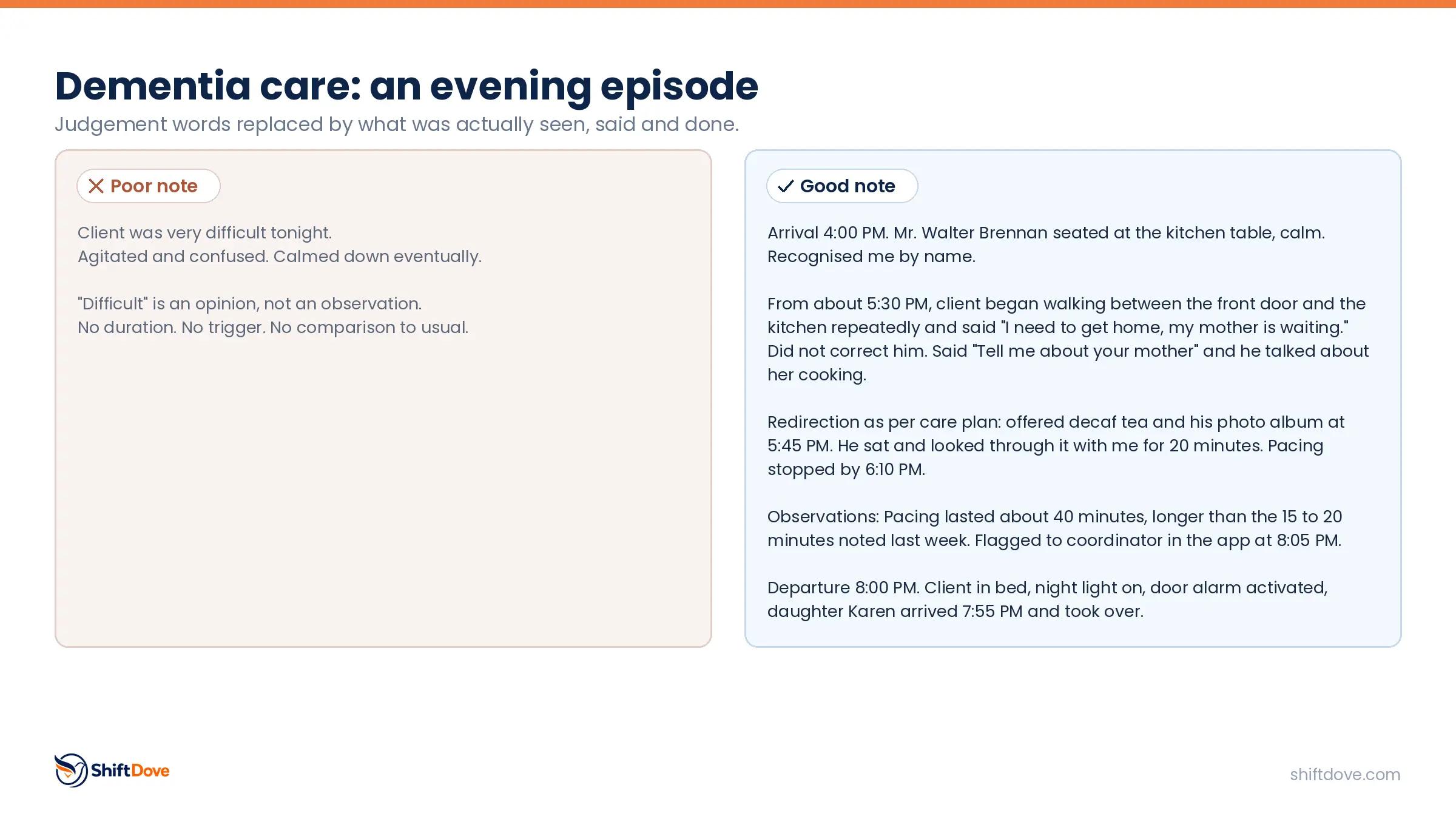
Example 3: Dementia care, sundowning in the eveningCopy link
Poor:
Good:
Example 4: Medication remindersCopy link
In many states and provinces, non-medical home care aides may remind or assist with self-administration but may not administer medication. Notes should reflect exactly what the aide's role allows.
Poor:
Good:
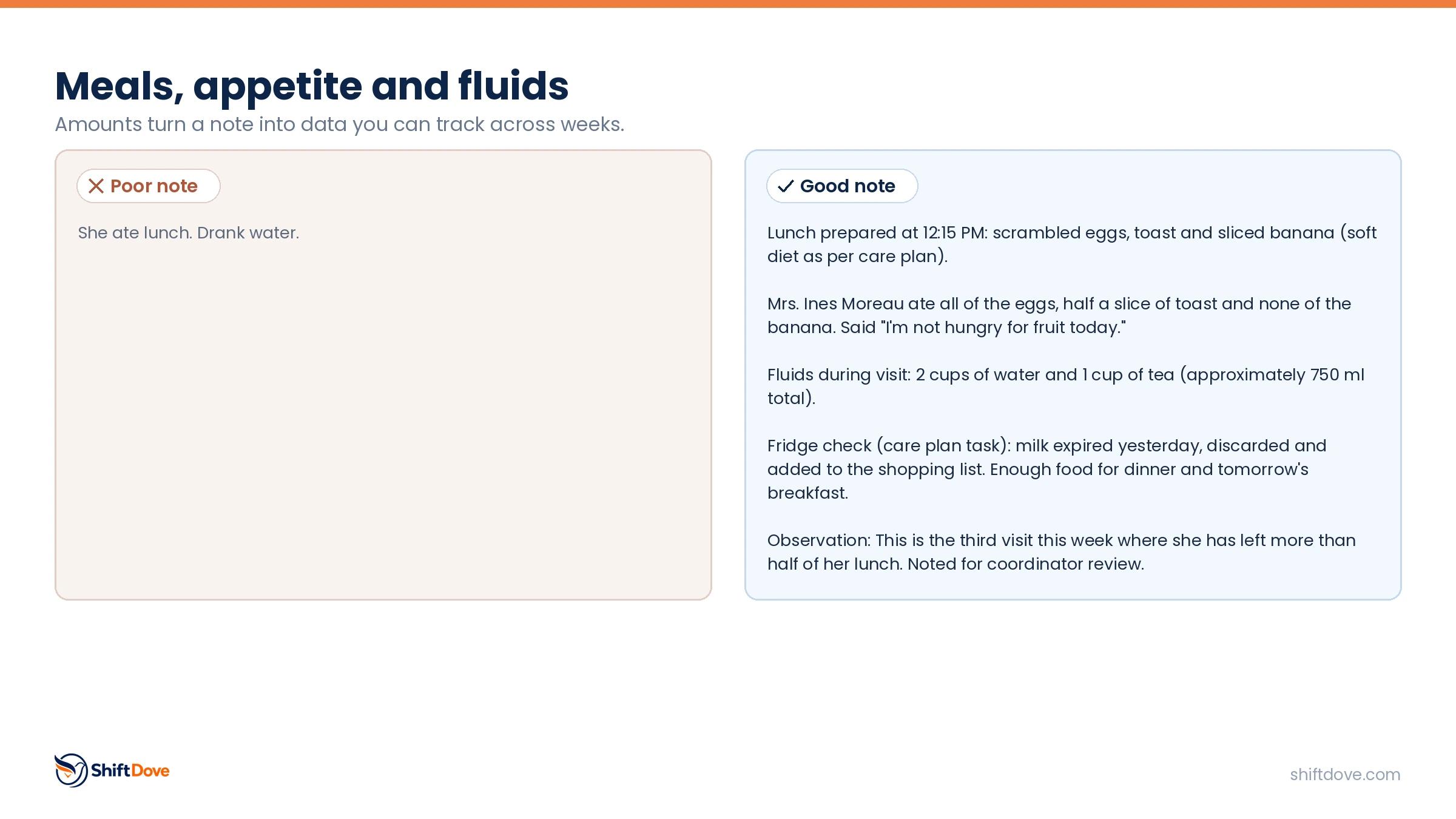
Example 5: Meals, nutrition, and fluidsCopy link
Poor:
Good:
Example 6: Mobility and transfersCopy link
Poor:
Good:
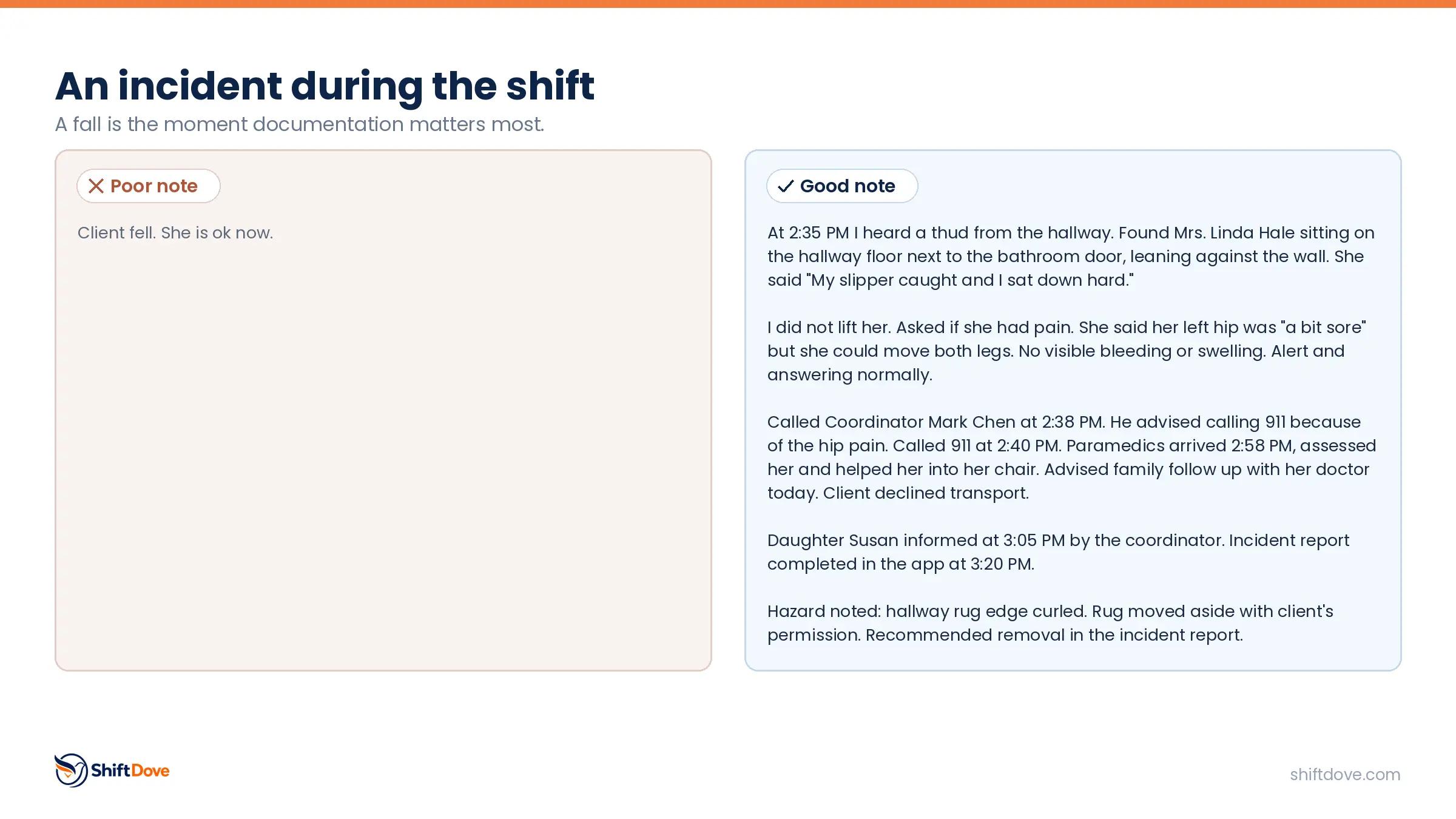
Example 7: A fall during the shiftCopy link
Poor:
Good:
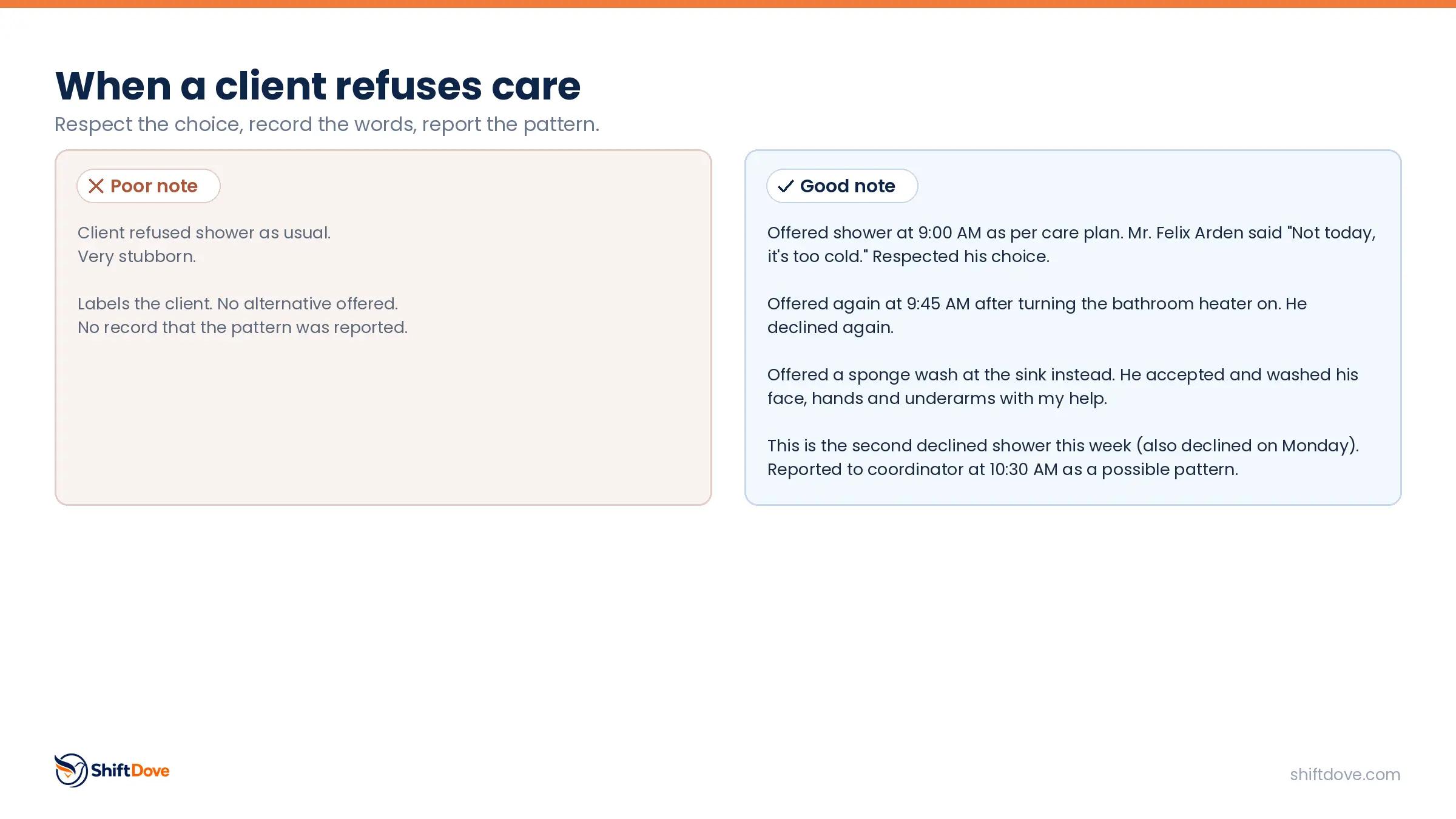
Example 8: Client refuses careCopy link
Poor:
Good:
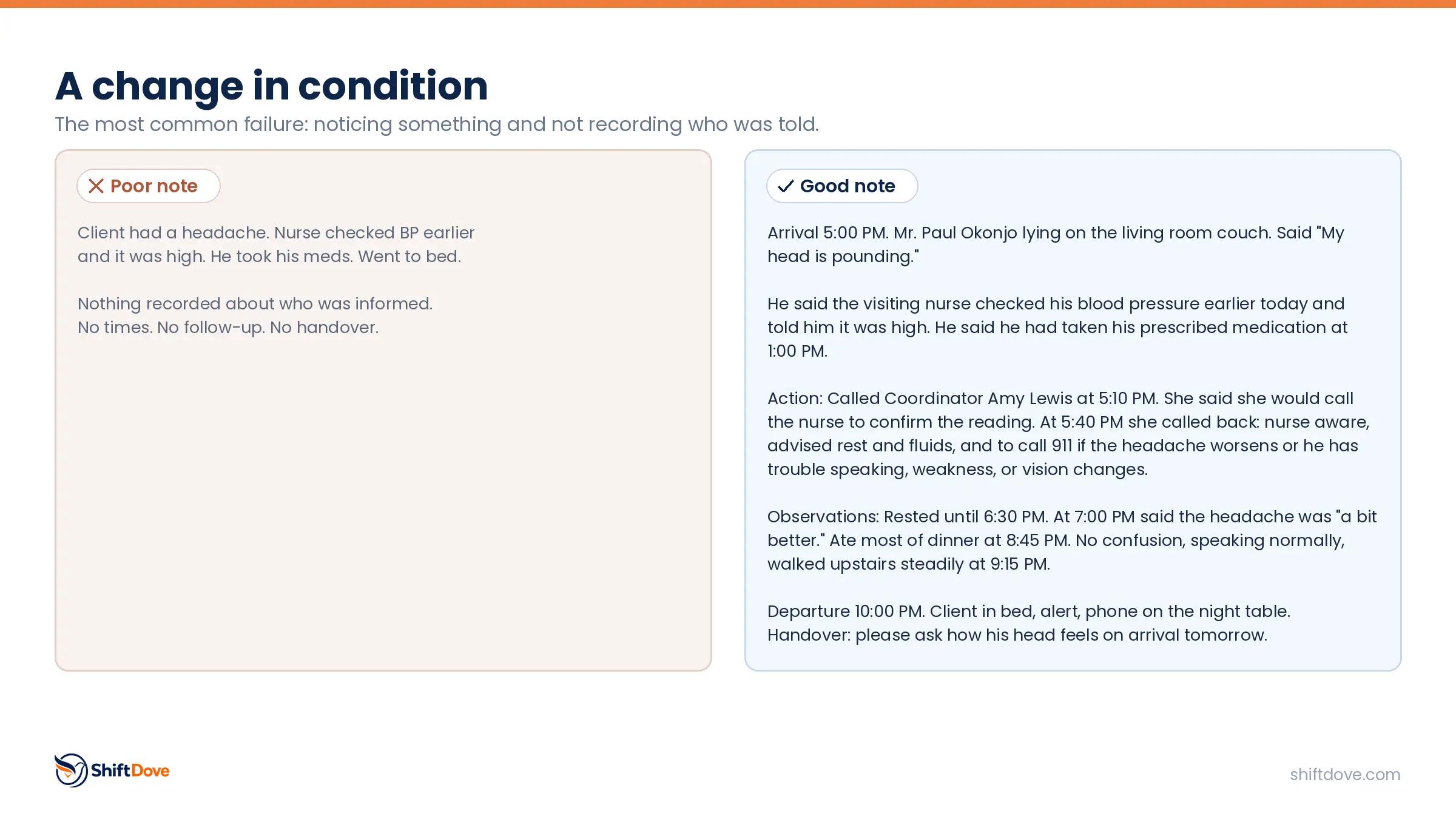
Example 9: A change in condition that needs escalationCopy link
This is the most common gap we see. A caregiver notices something, writes it down, and stops. The note must also show who was told and what happened next.
Poor:
Good:
Example 10: End-of-life and hospice support visitCopy link
Home care aides often work alongside a hospice team. Notes should focus on comfort, dignity, observations, and family support, and leave clinical assessment to the hospice nurse.
Poor:
Good:
Example 11: Overnight or sleepover shiftCopy link
Poor:
Good:
Example 12: Respite careCopy link
Poor:
Good:
Example 13: Home health aide visit under a nurse's plan of careCopy link
Poor:
Good:
Example 14: Disability support, community outingCopy link
Poor:
Good:
Example 15: Pediatric support visitCopy link
Poor:
Good:
Example 16: Housekeeping and home safetyCopy link
Poor:
Good:
Example 17: Shopping and errandsCopy link
Poor:
Good:
Example 18: Behaviour change worth watchingCopy link
Poor:
Good:
Example 19: Late entryCopy link
If a note is written after the shift, it should be clearly marked, not backdated.
Good:
Example 20: Correcting a mistakeCopy link
Never delete or overwrite an earlier note. Add a correction that explains what changed.
Good:
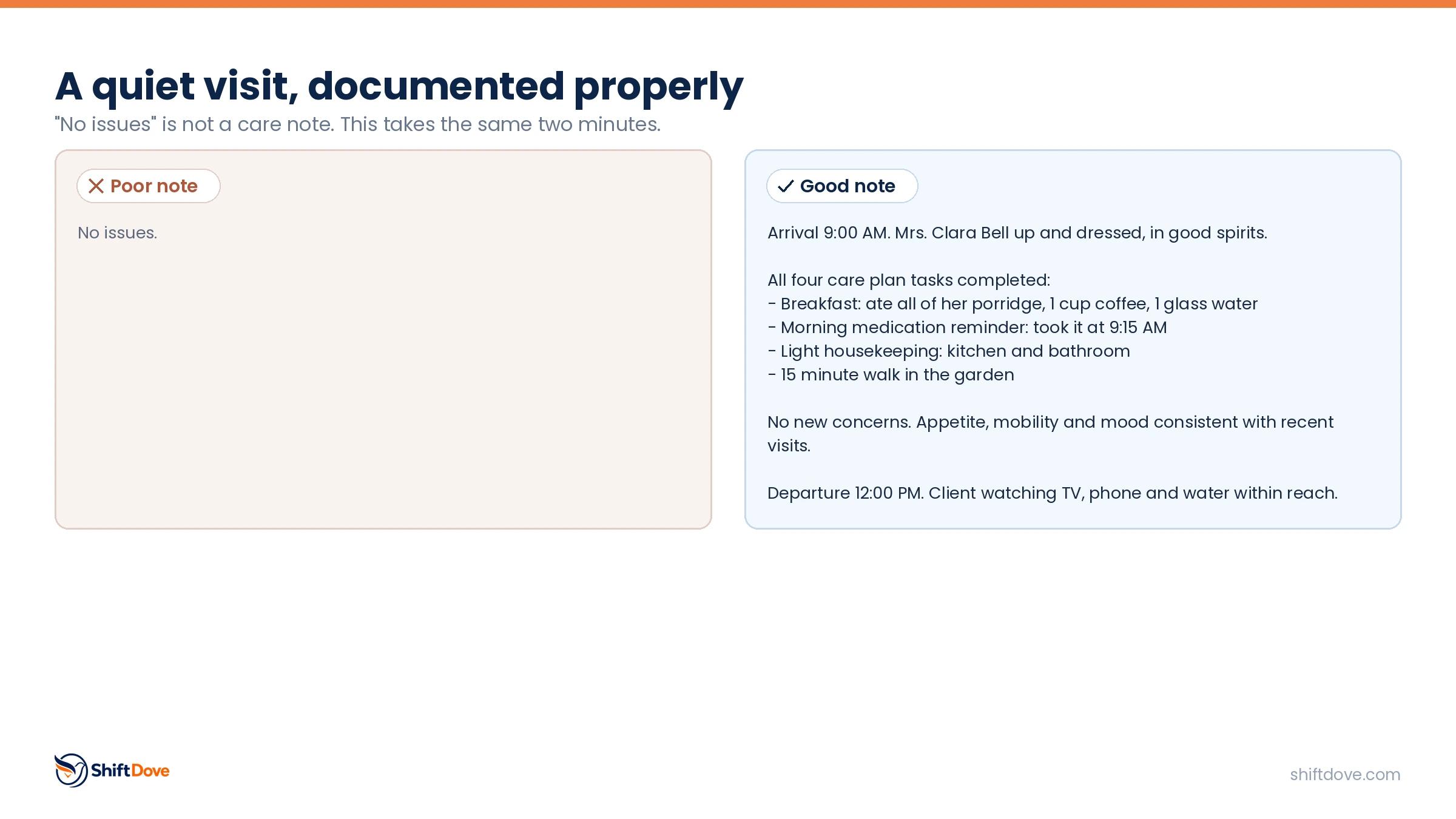
Example 21: A visit with no concerns, done properlyCopy link
"No concerns" is fine, but only after the tasks and observations are recorded.
Poor:
Good:
6. Shift tasks: why every visit should have themCopy link
The biggest single improvement most agencies can make to their care notes has nothing to do with writing. It is giving every shift a short, specific list of tasks.
Without tasks, a caregiver arrives with a general idea of the client's needs and writes whatever they remember. Some write a page. Some write a line. Nobody can easily tell whether the care plan was followed.
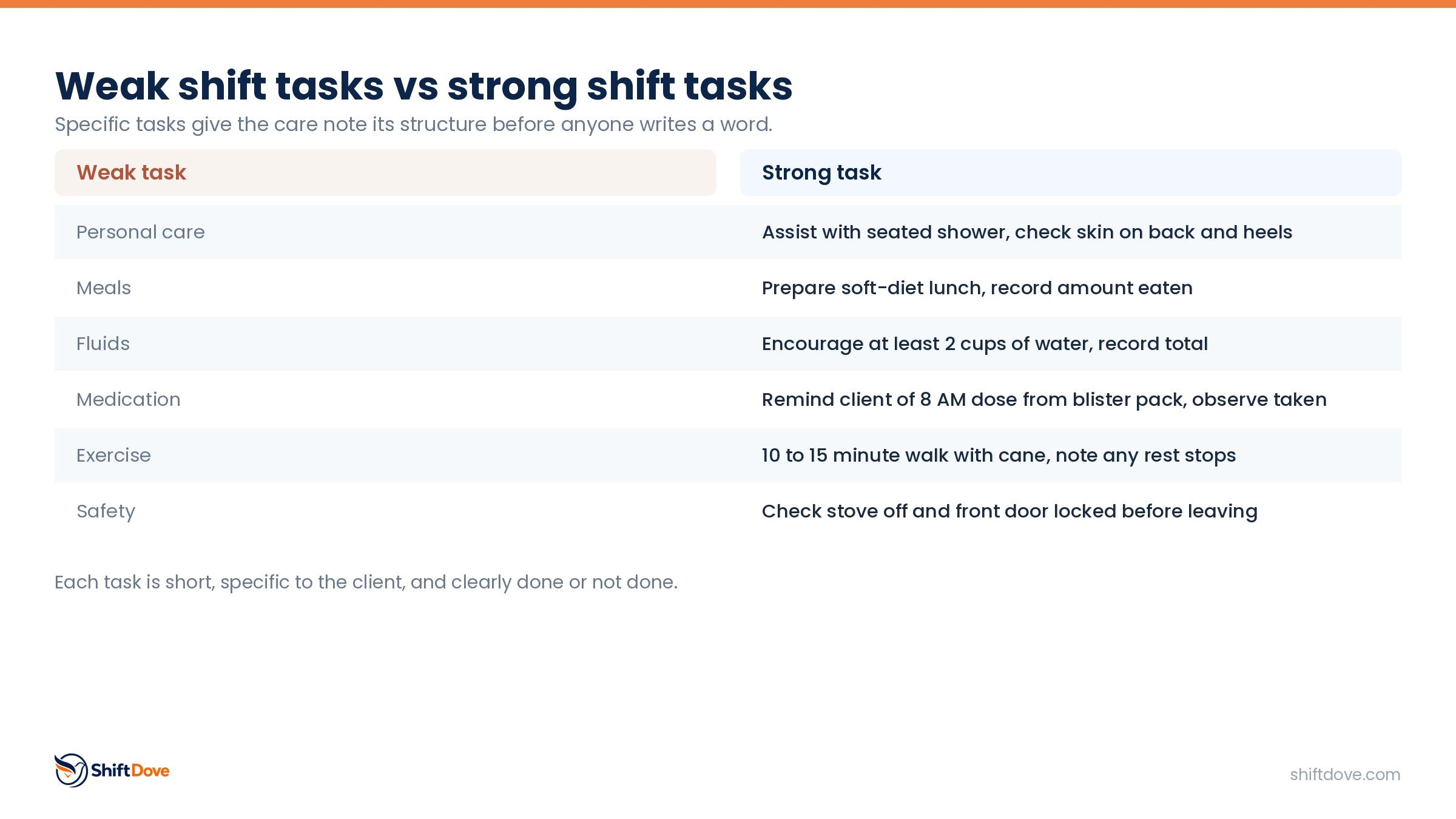
With tasks, every visit starts with a clear checklist drawn from the client's care plan: "seated shower," "check skin on heels," "remind 8 AM medication," "encourage 2 cups of fluid," "15 minute walk." The caregiver knows what is expected. The note has a natural structure. And the coordinator can see at a glance what was done and what was not.
Why agencies should adopt shift tasks:
- Consistency across caregivers. When a regular caregiver is off, the replacement follows the same plan.
- Care plan compliance. Every assigned task becomes visible as done, partly done, refused, or not needed.
- Better notes with less effort. Caregivers write about each task instead of trying to remember everything.
- Clear accountability. A missing task is obvious, not buried in a paragraph.
- Defensible records. In an audit or a dispute, you can show the plan and the evidence it was followed.
- Reporting. Over weeks, task data shows which tasks are often declined, skipped, or taking longer than expected.
How to write good shift tasks:
| Task | Weak | Strong |
|---|---|---|
| Personal care | Personal care | Assist with seated shower, check skin on back and heels |
| Meals | Meals | Prepare soft-diet lunch, record amount eaten |
| Fluids | Fluids | Encourage at least 2 cups of water, record total |
| Medication | Medication | Remind client of 8 AM dose from blister pack, observe it taken |
| Exercise | Exercise | 10 to 15 minute walk with cane, note any rest stops |
| Safety | Safety | Check stove off and front door locked before leaving |
Each task should be short, specific to the client, and something the caregiver can clearly mark as done or not done.
Set up care plans and shift tasks on ShiftDove · 30-day free trial of Pro, no credit card required.
7. Making sure tasks end up in the notesCopy link
Assigning tasks is only half of it. The other half is making sure every task is accounted for before the caregiver leaves.
Before the shift
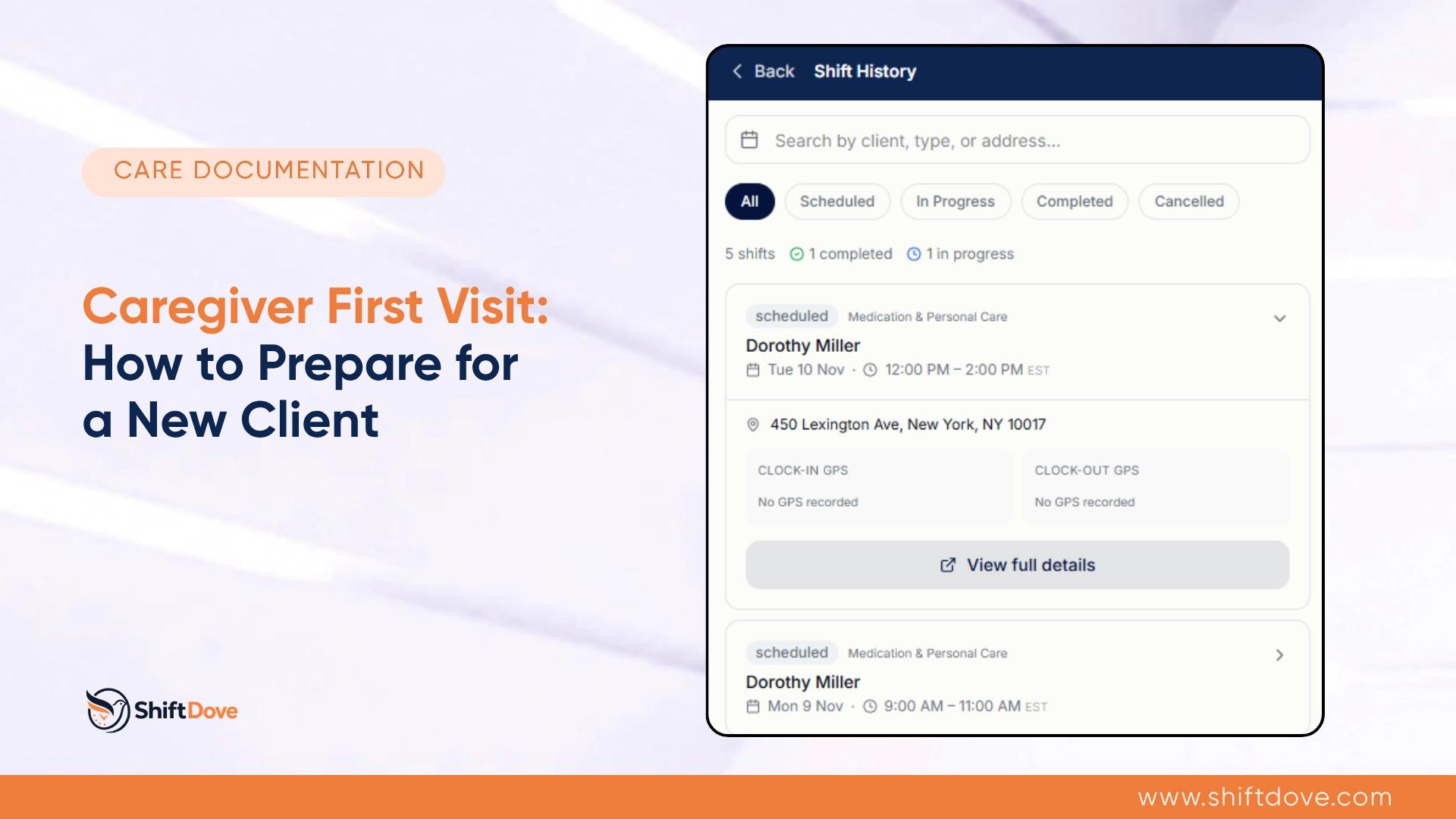
- Make tasks visible on the caregiver's phone as soon as they open the shift, not buried in a separate document.
- Flag any one-off instructions for that visit clearly, such as "Daughter dropping off new prescription, confirm it is put with the others" or "Nurse visiting at 2 PM, let her in."
- For new caregivers or new clients, ask the coordinator to talk through the tasks by phone before the first visit.
During the shift
- Encourage caregivers to update task status as they go, rather than reconstructing the whole visit at the end.
- Teach the rule: if a task was not done, write why. "Client declined," "client asleep, will offer at next visit," "supplies not available, reported to coordinator."
Before the shift ends
- Make the end-of-shift routine fixed: review the task list, write the note, then clock out.
- Ask for a short handover line in every note: "Next caregiver: please check..."
- If a task was not completed for a safety-related reason, the caregiver should contact the coordinator before leaving, not just write it down.
After the shift
- Coordinators review incomplete tasks the same day. A declined shower is minor once. Three in a week is a pattern that may need a care plan review or a family conversation.
8. What schedulers and administrators should checkCopy link
You do not need to read every note in full every day. You do need a routine. Here is a practical review checklist.
Daily, for every completed shift
- Is there a note at all?
- Was the note written close to the end of the shift, not hours later?
- Are all assigned tasks accounted for?
- Does every incomplete task have a reason?
- Is there any change in condition, incident, or concern? If so, does the note show who was told?
Weekly, by spot check
- Pick a sample of notes per caregiver and read them properly.
- Compare notes against clock-in and clock-out times. A note describing a 4:00 PM walk on a shift that ended at 3:30 PM is a problem.
- Look across several visits to the same client for patterns: falling appetite, more confusion, more help needed with transfers, repeated refusals.
Red flags in care notes
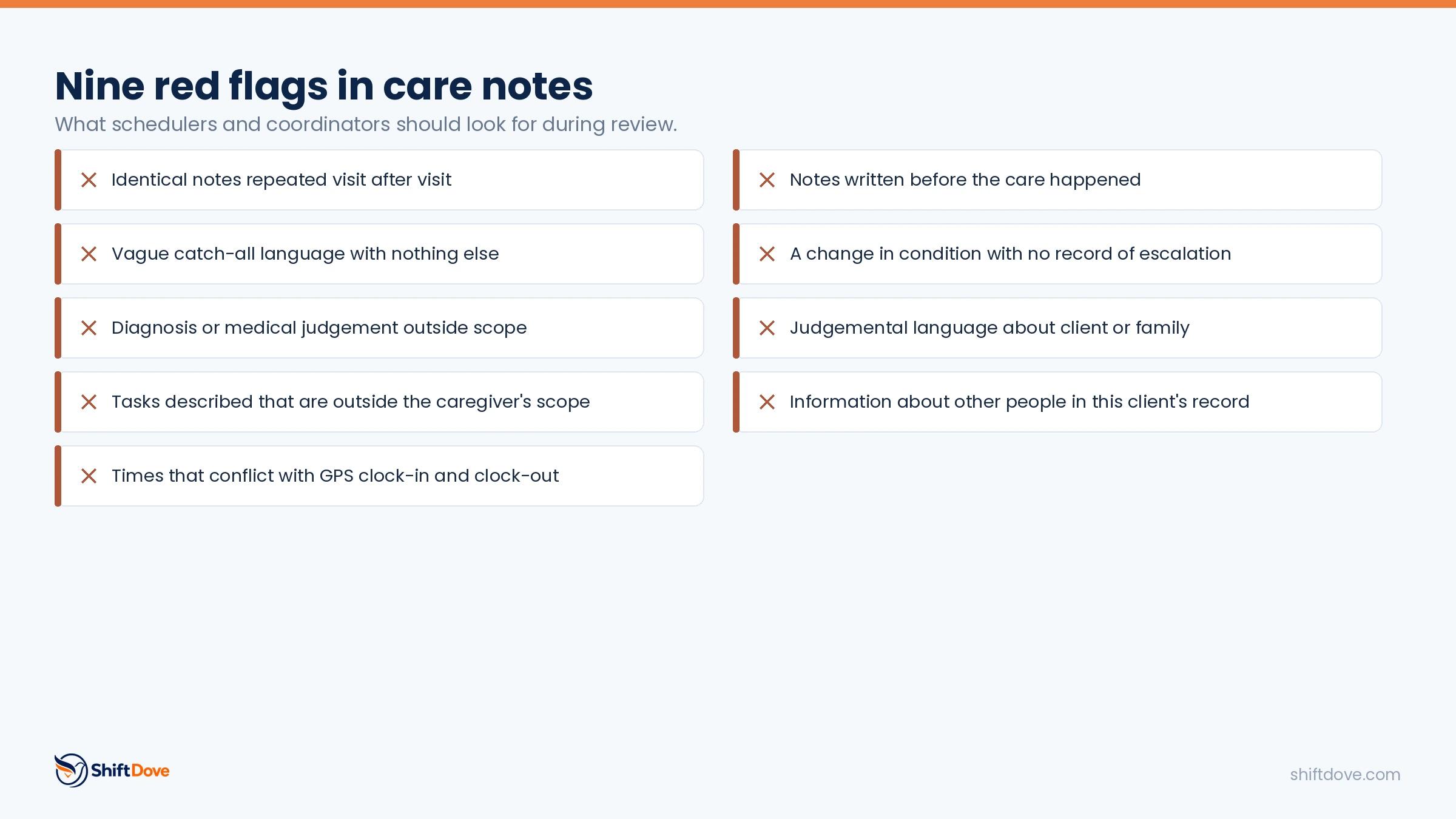
- Identical notes. The same wording visit after visit usually means copy and paste, not care.
- Notes written before the care happened. Check the note's timestamp against the shift.
- Vague catch-all language. "All good," "no issues," "client fine," with nothing else.
- Missing escalation. A change in condition written down with no record of who was told.
- Diagnosis or medical judgement outside the caregiver's role.
- Judgemental or emotional language about the client or family.
- Tasks outside the caregiver's scope. For example, a non-medical aide describing administering medication or changing a wound dressing. That may be a training issue, or a scheduling issue where the wrong person was sent.
- Information about other people that should not be in this client's record.
- Notes that do not match the visit record. Times or activities that conflict with GPS clock-in and clock-out data.
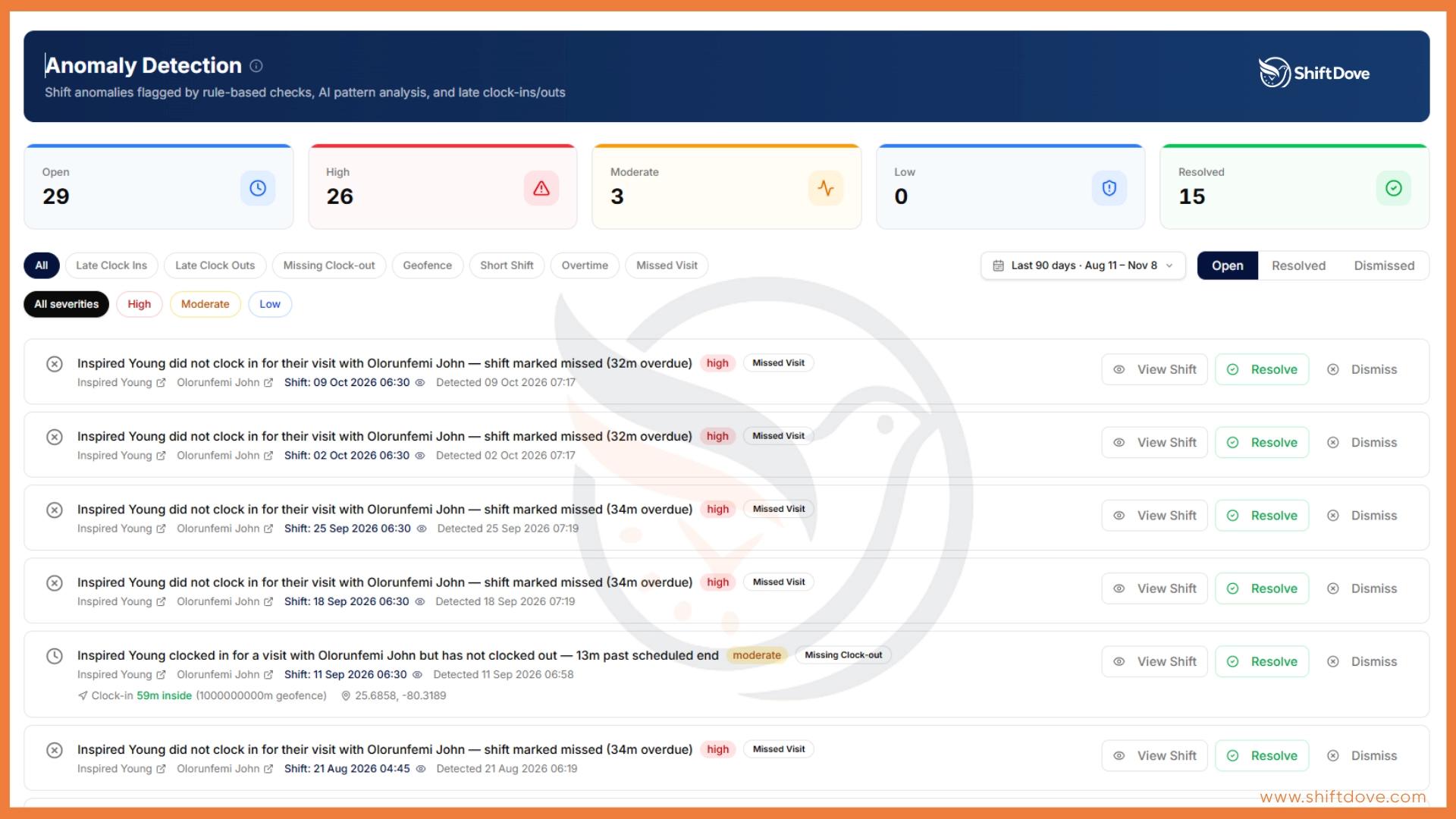
Shiftdove.com offers powerful shift anomaly detection built for home care agencies, home health care providers, and caregiver scheduling software users who need real-time visibility into every shift. Our anomaly detection software automatically flags
- Clock-in and clock-out irregularities
- GPS and geofencing mismatches
- EVV location errors
- Time-stamp deviations,
- Device spoofing,
- Late starts
- No-shows,
- Unapproved overtime before timesheets are approved for billing.
- and you can set your own detection rules. Shiftdove flags exactly what matters to you.
By comparing live GPS coordinates, mobile timestamps, biometric check-ins, and task entries against each caregiver’s historical patterns, Shiftdove helps coordinators catch scheduling risks early, reduce payroll fraud, and stay compliant with Electronic Visit Verification (EVV) requirements.
What makes Shiftdove’s anomaly detection different is how it protects both client safety and agency operations in one dashboard. The system detects documentation and task omissions like missing ADL and IADL checklists, shift note red flags, negative sentiment, and clinical keywords that signal a sudden change in a client’s condition. It also monitors client health and environmental shifts, including vital sign spikes from connected home-health devices, behavioral deviations, and unusual awake times during overnight care. Low-risk flags update the agency dashboard quietly, while high-risk alerts like a missing overnight check-in or a severe EVV mismatch and instantly notifying coordinators so they can send a replacement caregiver, contact the family, and prevent a missed visit.
9. Keeping caregivers compliant without micromanaging themCopy link
Most poor care notes are not laziness. They come from caregivers who were never shown what a good note looks like, are writing on a small screen at the end of a long day, and never hear back about what they wrote.
Write the standard down. A one-page documentation policy: what every note must include, how to handle refusals, incidents, late entries, and corrections. Keep it short enough to actually read.
Train with examples, not rules. Show caregivers a poor note and a good note side by side, like the ones above. Then have them rewrite a poor note themselves. It takes fifteen minutes and works better than any manual.
Use a template. A consistent structure, like the six parts in section 4, removes guesswork. Agencies can set the structure once and every caregiver follows it.
Give quick feedback. When a coordinator spots a weak note, a short, specific message ("Great detail on the walk. Next time, please add how much lunch she ate.") does more than a formal warning.
Recognise good documentation. Mention excellent notes in team messages. Caregivers who write well usually care well, and they should know it is noticed.
Make it part of performance reviews. Note quality, timeliness, and task completion belong next to punctuality and attendance. When it is measured, it improves.
Respect the caregiver's time. Notes should take minutes, not half an hour. Clear tasks and a simple structure make that possible.
Be clear about escalation. Every caregiver should know exactly who to call, and when, for falls, injuries, sudden changes, refusals of critical care, and medication problems. Then write it in the note.
10. Turning care notes into a history of careCopy link
One note is a snapshot. Six months of notes is the most detailed history anyone has of how a client is really doing at home.
Used well, that history lets an agency:
Spot decline early. A slow drop in appetite, more help needed with standing, more frequent night waking. Each is easy to miss on any single day and hard to miss across thirty visits.
Support care plan reviews. When it is time to reassess, you have evidence rather than impressions: which tasks are regularly declined, which take longer than planned, what has changed since the last review.
Keep families informed with facts. "She has eaten less than half her lunch on 7 of the last 10 visits" is a far better conversation than "she seems to be eating less."
Back up billing and hours. Notes tied to verified clock-in and clock-out times support every hour invoiced.
Hold up in audits and disputes. Consistent, timely, objective notes are the strongest record an agency can have.
Measure care quality, not just attendance. Task completion rates, documentation timeliness, and note quality by caregiver give a fair, evidence-based picture of performance.
This only works if the notes are consistent. That is the real case for structure, tasks, and review: not paperwork for its own sake, but a record that actually tells you something.
How ShiftDove helps agencies keep care notes consistentCopy link
ShiftDove is the home care operations platform built for agencies that want structure without the enterprise price tag. Agencies across the United States and Canada use it to run the whole operation in one place:
- Care plans and shift tasks so every visit has a clear checklist
- Staff notes on every shift, sitting right next to verified clock-in and clock-out times
- GPS clock-in and clock-out with electronic visit verification, showing the distance from the visit address
- Caregiver mobile app for tasks, notes, and shifts on the go
- Custom forms and assessments for documentation your agency or state requires
- Incident management for falls, injuries, and other events
- Care Signals AI and anomaly detection to flag patterns such as missing clock-outs or unusual clock-in behaviour
- Staff performance reviews built from real shift data
- Scheduling, AI scheduling, timesheets, payroll and invoice exports, document hub, onboarding, and reports
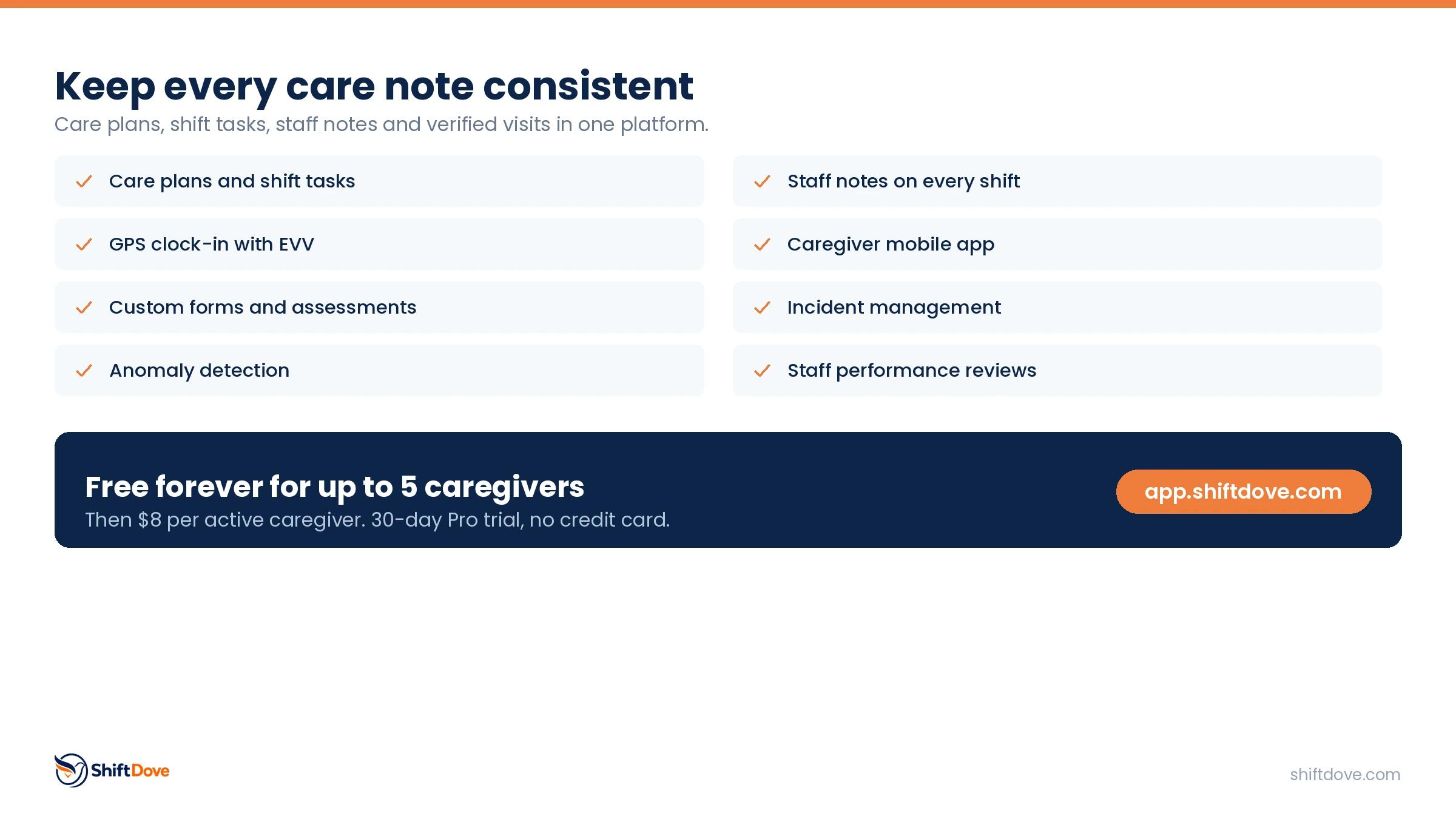
Pricing is simple. Free forever for agencies with up to 5 caregivers. The Pro plan is $8 per active caregiver per month with a $49 base rate, and you only pay for caregivers who actually worked a shift that month. Every Pro plan starts with a 30-day free trial, no credit card required. See the full breakdown on our pricing page, explore the platform, or read more about us.
Create your free ShiftDove account
11. Frequently asked questionsCopy link
What should a caregiver's care note include?Copy link
The date, arrival and departure times, each assigned task and its outcome, objective observations about mood, appetite, fluids, mobility, and skin, anything notable the client said, any concerns or incidents and who was informed, and the client's condition at departure.
How long should a care note be?Copy link
Long enough that the next caregiver knows exactly what happened and an auditor can see the care plan was followed. For a routine visit that is often 6 to 12 short lines. Visits with incidents or changes need more.
What is the difference between objective and subjective care notes?Copy link
Objective notes describe what was seen and heard: "Client said 'I'm tired' and slept from 1:00 PM to 2:30 PM." Subjective notes describe opinions: "Client seemed tired and lazy." Care notes should be objective, with the client's own words in quotation marks.
Should caregivers write care notes during or after the shift?Copy link
During the shift or immediately at the end of it, before clocking out. Notes written hours later are less accurate. If a note must be written later, it should be clearly marked as a late entry.
Can caregivers use abbreviations in care notes?Copy link
Only widely understood ones your agency has approved. Unclear abbreviations cause confusion and errors. When in doubt, write it out.
What should a caregiver do if a client refuses care?Copy link
Respect the decision, offer again or offer an alternative if appropriate, record the client's words, and report repeated or safety-related refusals to the coordinator. Write all of it in the note.
Can a care note be changed after it is submitted?Copy link
It should not be deleted or overwritten. Add a dated correction that explains what was changed and who changed it.
What are SOAP and DAR notes?Copy link
SOAP stands for Subjective, Objective, Assessment, and Plan, and is common in clinical settings. DAR stands for Data, Action, and Response. Non-medical home care aides usually do well with a simpler structure: arrival, tasks, observations, client's words, concerns and actions, and departure.
What are shift tasks in home care?Copy link
Shift tasks are specific, client-specific actions taken from the care plan and assigned to each visit, such as "seated shower" or "encourage 2 cups of fluid." They give caregivers a clear checklist and make it easy to confirm the care plan was followed.
How can agencies tell if care notes are being copied?Copy link
Look for identical wording across visits, notes that do not match the client's current situation, and note timestamps that do not line up with clock-in and clock-out times.
How do care notes help agencies during audits?Copy link
They provide evidence that each visit happened, that the care plan was followed, and that concerns were escalated properly. Notes tied to verified visit times are especially strong.
Do family members have access to care notes?Copy link
Clients and their authorised representatives can usually request their records, depending on your jurisdiction and agency policy. Write every note as if the client and family will read it.
The examples in this article use fictitious names and are for training purposes. Medication and clinical tasks that a home care aide may perform vary by state and province. Always follow your agency's policies and local regulations.